Darwin doesn’t get the attention it deserves. Australia’s northernmost capital is compact, yes—but it punches well above its weight. Where else can you plunge into a tank with a 5-metre saltwater crocodile in the morning, browse a multicultural night market at sunset, and spend the following day walking through ancient rock art galleries that predate most human civilizations?
This is a city shaped by tropical extremes, remarkable wildlife, and a wartime history that most Australians only vaguely know. Darwin attracts its fair share of visitors but still manages to feel genuinely unpolished in the best possible sense—raw, diverse, and unlike anywhere else on the continent.
Before you pack your bags, though, there’s one thing every Darwin visitor needs to understand: timing matters here more than almost anywhere else in Australia. The city runs on two seasons, and they’re not created equal. Get the timing right, and Darwin will exceed every expectation. Get it wrong, and you might find the highlights either inaccessible or frankly dangerous.
This guide covers the seven best things to visit in Darwin, essential safety advice that too many travel blogs skip over, and a handful of underrated gems worth adding to your itinerary.
When to Visit Darwin: Dry Season vs. Wet Season
Darwin’s climate divides neatly into two periods: the dry season (May–October) and the wet season (November–April).
The dry season is the clear winner for first-time visitors. Humidity drops, temperatures are more manageable, and the full range of Darwin attractions—including the Mindil Beach Sunset Market—run at capacity. Daytime temperatures typically hover around 30°C with low humidity, making outdoor exploration genuinely comfortable.
The wet season brings dramatic monsoon storms, spectacular lightning shows, and a landscape that turns lush and green almost overnight. It’s beautiful in its own way, but flooding can close key roads and cut off remote areas of Kakadu, including the iconic Jim Jim Falls. Coastal swimming is also more hazardous during the wet season due to box jellyfish activity.
For most travelers, the dry season (May–October) is the optimal window. The shoulder months of April and October often offer a sweet spot: fewer crowds and lower prices, while conditions remain mostly favorable.
1. Mindil Beach Sunset Market
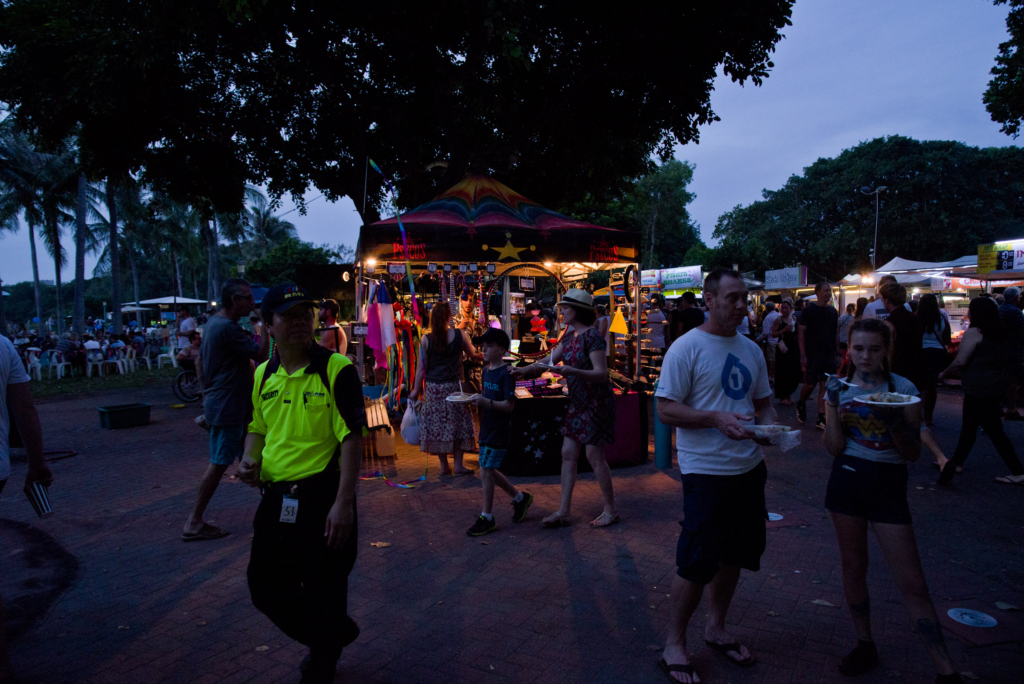
There are markets, and then there is Mindil Beach Sunset Market. Every Thursday and Sunday from 4 pm to 9 pm—running from the last Thursday in April through to the last Thursday in October—Darwin’s foreshore transforms into one of the most vibrant outdoor markets in Australia.
With 150+ stalls and approximately 60 food vendors representing cuisines from Vietnam, Thailand, Indonesia, India, Sri Lanka, Greece, and beyond, it’s the kind of place where decision fatigue sets in before you’ve even made it past the first row. Add live music, local arts and crafts, handmade clothing, and Indigenous products, and you have a market that genuinely reflects the multicultural character of the Top End.
The secret to doing Mindil properly is arriving early. Get there around 4–5 pm, browse the stalls before the crowds peak, find a stretch of beach, and watch one of the most spectacular sunsets in Australia unfold over the Timor Sea. Entry is free.
Practical tips:
- Go hungry. Portions are generous and the food variety is extraordinary.
- Thursday is the main market with all stalls trading; Sunday is a smaller, more local affair.
- The market is approximately 3 km from Darwin’s city centre—bus routes 4 and 6 both stop nearby, and free parking is available via Gilruth Avenue.
2. Cage of Death at Crocosaurus Cove
It’s one thing to see a saltwater crocodile from a safe distance. It’s another thing entirely to be lowered—in a clear acrylic enclosure—directly into the water with one. The Cage of Death at Crocosaurus Cove does exactly that.
Located in the heart of Darwin’s CBD on Mitchell Street, Crocosaurus Cove houses some of the largest saltwater crocodiles in captivity. The Cage of Death gives you 15 minutes face-to-face with a 5-metre-plus adult saltwater crocodile, descended via overhead monorail into the enclosure. Regular feeding by handlers during your time inside ensures the experience lives up to its name.
Pricing and conditions:
- 1 person per cage: $195
- 2 people per cage: $295
- Cage of Death bookings include full-day entry to Crocosaurus Cove
- Minimum age: 15 years
- Participants aged 15–17 must be accompanied by someone over 18 and have a parent-signed consent form
- Arrive 30 minutes before your session for the safety briefing
Beyond the Cage of Death, Crocosaurus Cove opens at 9 am and closes at 6 pm—leaving plenty of time for crocodile feeding shows, baby croc handling sessions, and interactions with pythons and lizards. During peak dry season months (June–August), cage slots fill days in advance, so pre-booking is strongly recommended.
3. Darwin Waterfront Precinct & Wave Lagoon
Here’s a reality check that catches many Darwin visitors off guard: swimming in the city’s natural waterways—including Darwin Harbour’s beaches—is generally not safe due to saltwater crocodiles and box jellyfish. The Darwin Waterfront Precinct is the answer to that problem.
The Wave Lagoon is the centrepiece: a 4,000-square-metre, stinger-free and crocodile-free swimming lagoon that generates up to 1.2-metre waves across 10 different wave patterns—from gentle swells to proper surf-worthy sets perfect for boogie boarding. Waves run in cycles with a 20-minute break between each, and lifeguards are stationed at all times.
General admission:
- Under 3 years: Free
- Under 15 years: $6
- 15 years and over: $8
- Seniors concession: $6
- Family (max 2 adults and 3 children): $25
The kiosk is open daily from 10 am to 6 pm, selling snacks, drinks, and hire equipment. Sun loungers, accessible showers, and lockers round out the facilities. Beyond the lagoon, the broader Waterfront Precinct houses restaurants, cafes, and the Aqua Park—making it an easy full-day outing for families and solo travelers alike.
4. Jumping Crocodile Cruise on the Adelaide River
Located approximately 60 kilometres east of Darwin—around a 45-minute drive—the Adelaide River offers one of the most visceral wildlife encounters available anywhere in Australia. Tour operators dangle raw meat from poles above the water’s surface, and the river’s enormous saltwater crocodiles launch themselves vertically out of the water to snatch it.
These crocodiles are wild. They haven’t been trained or conditioned beyond learning to associate boats with food, which makes the sheer power and speed of their jumps all the more remarkable to witness. It’s educational, too—guides typically explain crocodile behavior, the conservation history of the species in the NT, and what makes these animals such effective apex predators.
Morning cruises tend to see higher croc activity. Wear sun protection, check tour availability before heading out (the wet season can affect river levels), and book with a reputable operator—several depart directly from Darwin. A half-day trip including travel time is very manageable as a standalone excursion.
5. Kakadu National Park
No Darwin travel guide is complete without Kakadu, and it deserves more than a cursory mention. Located 240 kilometres east of Darwin, this park covers almost 20,000 square kilometres—a landscape so vast and biologically diverse that it has been inscribed on the UNESCO World Heritage List in three separate stages: 1981, 1987, and 1992.
The Traditional Owners, Bininj/Mungguy people, have lived on and cared for this country for more than 50,000 years—making this one of the oldest continuously inhabited landscapes on earth. The park is jointly managed by the Traditional Owners and Parks Australia, and that relationship is central to the Kakadu experience. Follow all posted signage, respect closed areas, and approach the cultural sites with the gravity they deserve.
Kakadu contains more than one-third of all Australian bird species and an extraordinary range of freshwater and estuarine fish. Its landscapes shift dramatically from coastal estuaries and floodplains to rocky escarpments and stone country—each habitat supporting entirely different wildlife.
Top highlights:
- Yellow Water Wetlands: the best single location for wildlife spotting, particularly in the dry season when animals concentrate around water
- Nourlangie Rock: one of the most accessible and significant Aboriginal rock art sites in the world
- Jim Jim Falls: accessible only in the dry season and requiring a 4WD—but the payoff is one of the most dramatic waterfalls in Australia
- Cahills Crossing: a tidal crossing where saltwater crocodiles gather in remarkable numbers
Kakadu genuinely rewards at least two days—consider staying overnight at Cooinda Lodge near Yellow Water, or in Jabiru for a more central base. Check Parks Australia’s website for current road conditions and permit requirements before you travel, particularly after the wet season when some tracks remain closed well into May.
6. Darwin Military Museum & the Bombing of Darwin
On 19 February 1942, Darwin was struck by Japan’s most devastating coordinated air raid outside of Pearl Harbor. According to the National Archives of Australia, 188 aircraft were launched from four Japanese aircraft carriers in the Timor Sea in the first wave, with a second raid of 54 land-based bombers following approximately 90 minutes later. The two raids killed approximately 235 people, with Australian War Memorial historians concluding a figure of “about 243” after accounting for crew members whose records were incomplete.
It remains one of the least-discussed major attacks in Australian history—which makes visiting the Darwin Military Museum at East Point Reserve all the more worthwhile. The museum houses one of the most significant collections of WWII military equipment in Australia, including original artillery guns, vehicles, and aircraft used in the defence of Darwin and the broader Northern Territory campaign.
Pair the museum with the Defence of Darwin Experience, an immersive multimedia attraction that recreates the sounds, images, and tension of the 1942 attack with considerable impact.
Set within the beautiful East Point Reserve—a coastal reserve with sweeping harbour views—the museum complex deserves at least two to three hours. Arrive early to explore the Reserve itself before the heat builds.
7. Darwin Harbour Sunset Cruise
A Darwin sunset needs to be seen from the water. The harbour frames the colours differently—vivid oranges and deep pinks reflecting off the calm surface of the Timor Sea in a way that’s almost unreasonably photogenic. Multiple operators run sunset cruises from Darwin Harbour, with options ranging from relaxed sightseeing tours to dinner cruises featuring fresh local seafood.
Book in advance during the dry season, particularly on weekends, when popular cruises sell out regularly. For a full sunset-themed day, consider pairing a weeknight harbour cruise with a Mindil Beach Sunset Market visit earlier the same afternoon.
Safety in Darwin: What Every Visitor Must Know
This section matters. Darwin’s appeal is inseparable from its wild environment, and that environment demands respect.
Crocodile safety
The NT Government’s official Be Crocwise guidance is clear: “It should be assumed that any water body in the saltwater crocodile’s natural range in the NT is unsafe to swim, unless signposted otherwise.” Most fatal crocodile attacks in the NT in the past 20 years have occurred when people entered the water outside of designated swimming areas. Only swim where there are designated safe swimming signs. When in doubt, stay out.
Box jellyfish (stinger) season
According to NT Health, the official stinger season runs from 1 October to 1 June, though stings have been recorded in all months of the year. The Chironex fleckeri—the major box jellyfish—carries the most rapidly acting venom known to science and is capable of killing a person in under five minutes. Children are at greater risk due to smaller body mass.
If stung:
- Get out of the water immediately
- Call 000
- Pour vinegar over the sting to stop further discharge—do not use fresh water
- Seek urgent medical attention
If swimming in open coastal waters during stinger season, wear a full stinger suit. The Darwin Waterfront Wave Lagoon remains the safest and most enjoyable swimming option year-round.
Hidden Gems Most Tourists Skip
George Brown Darwin Botanic Gardens: Free entry, beautifully maintained, and home to an impressive tropical plant collection. A calm counterpoint to the busy Waterfront.
Litchfield National Park: About 100 kilometres south of Darwin, Litchfield is often overshadowed by Kakadu but delivers spectacular waterfalls, natural swimming holes, and iconic magnetic termite mounds in a far more accessible format. Some swimming holes here are safe year-round—check current signage on arrival.
Stokes Hill Wharf: Historically significant as the site of some of the most intense bombing damage in 1942, and today a relaxed spot for a waterfront meal with great harbour views.
Plan Your Trip to Darwin
Darwin is a city that rewards those willing to go beyond the obvious. The wildlife encounters are world-class, the wartime history is profound, the sunsets are genuinely among the most spectacular in Australia, and the cultural depth—particularly through Kakadu and the city’s multicultural markets—offers something that few Australian destinations can match.
Aim for the dry season (May–October) for the best conditions and full access to attractions. Check Parks Australia’s website for Kakadu road conditions before you travel, and bookmark the NT Government’s tourism site for the latest visitor information.
Whatever brings you to Darwin—a crocodile cage dive, an evening at Mindil Beach, or a walk through 50,000 years of living culture—make the trip. It’s worth every kilometre.