Two airlines. One question. Every time you book a domestic flight in India, the same choice comes up: IndiGo or Air India?
One is India’s dominant low-cost carrier, holding over 60% of the domestic market. The other is a century-old flag carrier reinventing itself under Tata Group ownership, pouring hundreds of millions into new aircraft and refurbished cabins. Both have loyal passengers. Both have frustrated passengers. And depending on what you value — price, comfort, reliability, or route coverage — the right answer could be very different.
This post pulls together verified data across eight comparison points: operational performance, fleet, route network, pricing, in-flight experience, boarding and ground services, and ultimately, which airline wins for different types of travelers.
Executive Summary
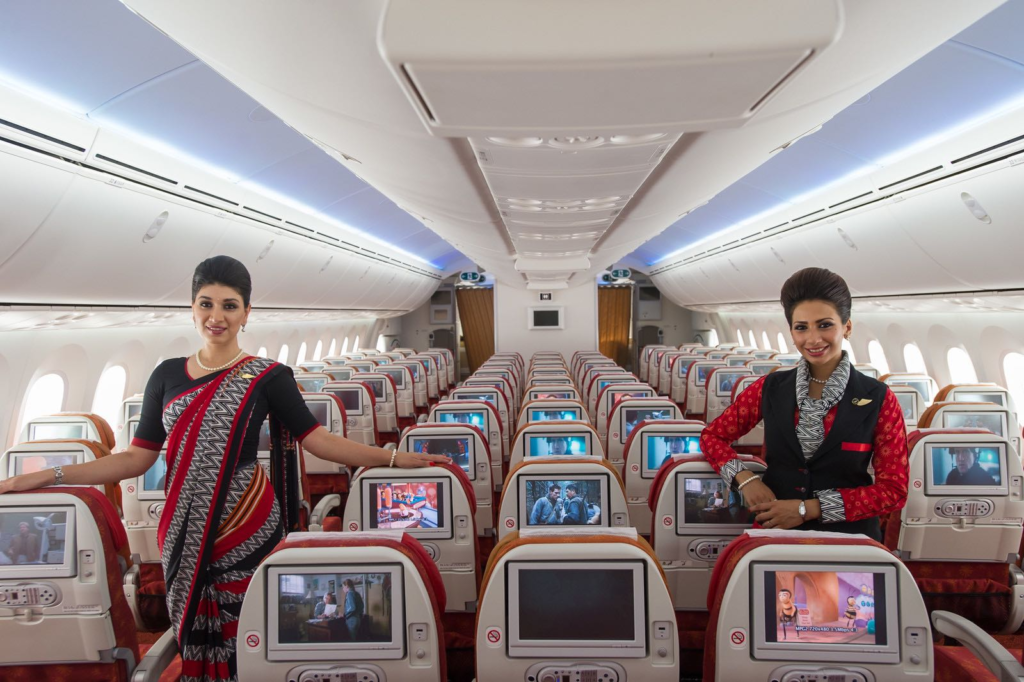
IndiGo and Air India represent two distinct philosophies. IndiGo is a lean, high-frequency, point-to-point machine built to move passengers cheaply and on time. Air India is a full-service carrier mid-transformation — offering meals, wider cabins, Business and Premium Economy classes, and growing international ambitions — but at a higher base cost and with some legacy operational baggage.
Neither airline is universally better. The answer depends on the journey.
Operational Performance: On-Time, Cancellations, and Complaints
This is where the comparison gets very specific, and where real data tells a clear story.
According to the DGCA’s performance report for May 2024, IndiGo led all domestic airlines with an 84% on-time performance (OTP) at the four major metro airports (Bengaluru, Delhi, Hyderabad, Mumbai). Air India recorded 79% OTP for the same period — a meaningful gap in a market where delays cascade across tight turnaround schedules.
By December 2024, IndiGo still led with a 73.4% OTP across major metros, while the Air India Group achieved 67.6%, according to aviation analytics platform Live From A Lounge.
Cancellation rates tell a more nuanced story. IndiGo’s average cancellation rate in 2025 was approximately 0.76%, according to fact-checking platform FACTLY. However, the airline experienced a significant operational breakdown in late 2024, when its December cancellation rate surged to 9.65% — more than twelve times its typical level — affecting over 9.8 lakh passengers in a single month. This spike was linked to large-scale technical and operational disruptions. The DGCA report for May 2024 recorded the overall domestic cancellation rate at 1.70% for that month.
Passenger complaints also favor IndiGo on a per-passenger basis. In May 2024, Air India received 197 complaints at a rate of 1.0 per 10,000 passengers. IndiGo received 115 complaints — but at just 0.1 per 10,000 passengers, reflecting its significantly higher passenger volumes. On absolute redressal, both airlines closed 100% of complaints that month.
On denied boardings and delays beyond two hours, Air India affected 50,605 passengers with delays in May 2024 versus IndiGo’s 46,902 — though again, IndiGo operates roughly four to five times more flights.
Edge: IndiGo on OTP and complaint rate. Air India is improving, but the gap remains.
Fleet & Aircraft: Age, Models, and What’s Coming
Fleet age matters because newer aircraft are more fuel-efficient, more reliable, and generally quieter and more comfortable.
IndiGo has been recognized as operating the world’s youngest commercial fleet (100+ aircraft category) for three consecutive years by aviation data firm ch-aviation. Its average fleet age is 4.38 years, and its fleet of over 400 aircraft includes Airbus A320s, A321neos, ATR 72s, and a small number of Boeing 737s and 777s for international routes. The A321neo models average just 2.6 years old.
Air India has a total active fleet of around 191 aircraft with an average age of approximately 8.1 years, according to Planespotters.net data cited by ThePrint (June 2025). Its fleet includes the Airbus A319, A320, A321, A350, and Boeing B787-8, B787-9, and B777 series. The 33 active Boeing 787 Dreamliners average 9.6 years old; the 787-8 variant averages 10.9 years.
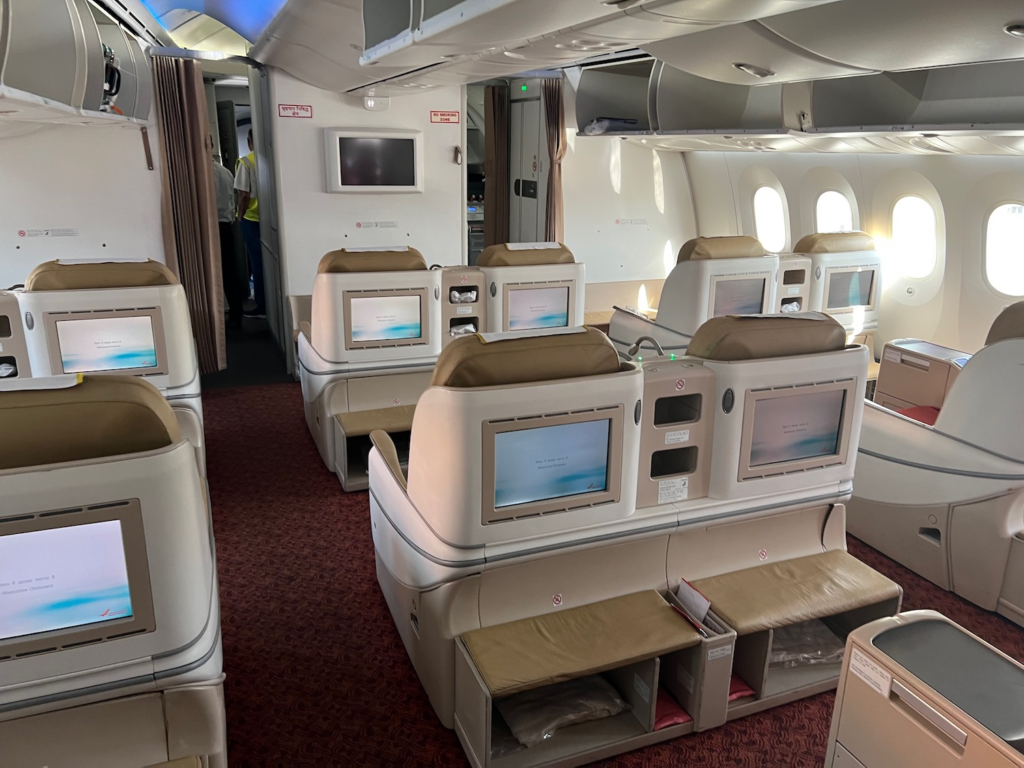
Where Air India gains ground is in widebody availability. It operates twin-aisle Boeing 777s and 787s on both international and some long-haul domestic routes, offering a cabin experience IndiGo simply cannot match on narrowbody aircraft. Business Class on Air India’s refurbished widebodies includes lie-flat seats — a product IndiGo’s domestic network does not offer.
Fleet expansion plans are significant for both. Air India has placed firm orders for 470 aircraft (250 Airbus, 220 Boeing) and confirmed an additional 100 Airbus aircraft in December 2024, totaling 570 on order. A $400 million retrofit programme is underway on 67 legacy aircraft — 27 single-aisle and 40 twin-aisle — upgrading seats, carpets, lavatories, and interiors. As of April 2025, over 50% of Air India’s fleet (106 of 198 aircraft) already has new or upgraded interiors.
IndiGo, meanwhile, continues to receive A321neo deliveries as part of one of the largest narrowbody order books in Asia.
Edge: IndiGo on fleet freshness; Air India on widebody availability and cabin class variety.
Route Network: Domestic Depth vs. International Reach
IndiGo currently serves over 125 destinations and operates the most flights of any Indian carrier, accounting for approximately 61.6% of domestic passenger market share as of May 2024 (DGCA data). Its network is built on high frequency on trunk routes and deeper regional penetration via its ATR fleet — covering tier-2 and tier-3 cities that larger jets cannot serve economically.
Air India holds roughly 13–14% domestic market share but punches above that weight internationally. Its international network spans destinations across Europe, North America, the Middle East, and Southeast Asia — routes IndiGo covers in limited form. Air India is also adding international routes as part of its Vihaan.AI transformation, with six new international routes added in the first phase alone.
For hub strategy, IndiGo treats Delhi (IGI) as its primary hub, with strong bases at Mumbai, Bengaluru, and Hyderabad. Air India operates from Delhi and Mumbai as dual international gateways, with codeshare agreements extending its effective reach further.
Regional connectivity: IndiGo’s ATR 72 fleet makes it dominant for remote and underserved routes. Air India’s regional operation runs through its Air India Express and AIX Connect subsidiaries rather than the mainline carrier.
Edge: IndiGo for domestic frequency and regional access; Air India for international network breadth.
Pricing Analysis: What You Actually Pay
Base fare comparisons favor IndiGo on most domestic routes — its low-cost model is built around low upfront prices with ancillary add-ons. Air India includes complimentary meals and standard baggage on all fare types (Value, Classic, and Flex), which shifts the value calculation once you factor in add-on costs.
Seat Selection
IndiGo charges for most preferred seats. On A320-family aircraft, seat fees range from free (middle seats in rear rows) to INR 2,700 for front-row window seats. Exit row and extra-legroom seats (rows 12–13 on A320-186 seat config, which offer at least 83.8cm legroom vs. 73.7cm standard) carry a premium of INR 400–1,100. For Flexi Plus fare holders, standard seats are free. IndiGo UpFront fare includes all seat selection at no extra charge.
Air India includes seat selection for certain fare classes; the Classic and Flex fares offer lower or no change fees and better flexibility. Its Smart Fares page does not publish specific INR seat selection amounts publicly in the same granular way as IndiGo.
Change and Cancellation Fees
IndiGo’s standard domestic cancellation fees (non-UpFront): INR 3,999 (24–72 hours before departure) and INR 4,999 (3–24 hours before). Change fees are INR 2,999 regardless of timing beyond 3 hours. The UpFront fare reduces this substantially: cancellation fees drop to INR 799–1,599, and changes are free if made more than 72 hours before departure (INR 299 within 72 hours). A 24-hour free cancellation applies to domestic bookings made at least 7 days before travel.
Air India’s Flex fare allows rescheduling at no cost and cancellation fees as low as INR 1,000. Classic fares offer lower-than-standard cancellation fees (up to 50% off the base fee). Value fares carry standard fees. Air India does not publish a single INR cancellation fee table publicly in the same structured format as IndiGo.
Airport Counter Charges
IndiGo charges an additional fee of up to INR 500 per person per sector for cancellations made through its call centre. Call centre seat booking also attracts an additional charge.
Edge: Air India for pricing transparency on meal inclusion and higher-fare flexibility; IndiGo for lower base fares on budget bookings.
The In-Flight Experience: Seat Pitch, Legroom, and Comfort
This is where the two airlines diverge most sharply — but the comparison depends on fare class and aircraft type.
Seat Pitch and Legroom
IndiGo’s standard economy pitch on A320-family aircraft sits at approximately 73.7cm (29 inches), which is typical for short-haul narrowbody economy. Extra-legroom rows (rows 12–13 on the A320-186) offer at least 83.8cm, confirmed in IndiGo’s official seat information. On Air India’s domestic A320neo fleet (now being retrofitted), economy pitch is broadly comparable. Where Air India gains is on widebody domestic operations: Boeing 787 and 777 cabins offer more cabin width and overhead bin volume, even in economy.
Meals
IndiGo is a buy-on-board carrier for standard fares; the UpFront fare includes one complimentary snack combo (1 snack + 1 beverage). Air India serves complimentary hot meals on all domestic flights across all fare types — Value, Classic, and Flex. This is a meaningful differentiator for flights over 90 minutes.
Cabin Cleanliness
Both airlines receive mixed passenger feedback on cleanliness, which varies by aircraft age and turnaround quality. IndiGo’s younger fleet tends to show less wear, but its high seat density and rapid turnarounds leave less time for thorough cleaning. Air India’s legacy aircraft have historically drawn more complaints on seat and cabin condition, though the $400 million retrofit programme is directly addressing this.
Crew Experience and Announcement Style
IndiGo’s cabin crew are trained for efficiency — announcements are standardized, concise, and largely focused on safety and schedule information. The overall experience is functional and professional. Air India’s crew service has historically been more formal, with fuller service cadences on medium and long-haul routes; its domestic short-haul product is more comparable to IndiGo but with meals included.
Overhead bin availability tends to be tighter on high-density IndiGo configurations (A320-186 seater, A321-232 seater) given the higher passenger count. Air India’s widebody flights have considerably more overhead storage per passenger.
Edge: Air India for meal inclusion, cabin class variety, and widebody comfort on applicable routes.
Boarding & Ground Services
IndiGo’s boarding process reflects its operational efficiency focus. Its high OTP is partly a function of strict turnaround discipline, with boarding typically beginning 30–40 minutes before departure. The airline does not include priority boarding in standard or UpFront fares; Fast Forward (priority check-in and anytime boarding) must be purchased separately.
Air India’s boarding process is generally less regimented by tier on domestic routes, though premium class passengers board first. Ground staff quality is inconsistent across stations, which has been noted in customer feedback.
Both airlines allow web check-in 48 hours before domestic departure.
Edge: IndiGo for boarding efficiency and turnaround speed.
Verdict: Which Airline Wins?
There is no single winner. The right choice depends entirely on what you’re optimizing for.
Choose IndiGo if:
- You’re booking a budget domestic trip and want the lowest base fare
- On-time departure is your top priority
- You need to reach a tier-2 or tier-3 city on a regional ATR route
- You’re flexible on meals and comfortable buying what you want
Choose Air India if:
- You want a complimentary hot meal included on every domestic flight
- You’re flying internationally and need a full-service carrier with widebody options
- You’re a Business Class traveler who needs lie-flat seats on long-haul routes
- You prefer a single carrier for a mixed domestic-international itinerary
The Bottom Line
IndiGo runs India’s most reliable and extensive domestic operation — the numbers back this up. Its 84% OTP, 4.38-year average fleet age, and 60%+ market share are not coincidental; they reflect a finely tuned low-cost model. Air India, meanwhile, is in the middle of the most ambitious airline transformation in Indian aviation history. The retrofit programme, the 570-aircraft order book, and new international routes are real signals of where the carrier is headed.
The gap between them is narrowing. For now, IndiGo wins on value and punctuality, Air India wins on service and international reach. In a few years, that calculus may look quite different.