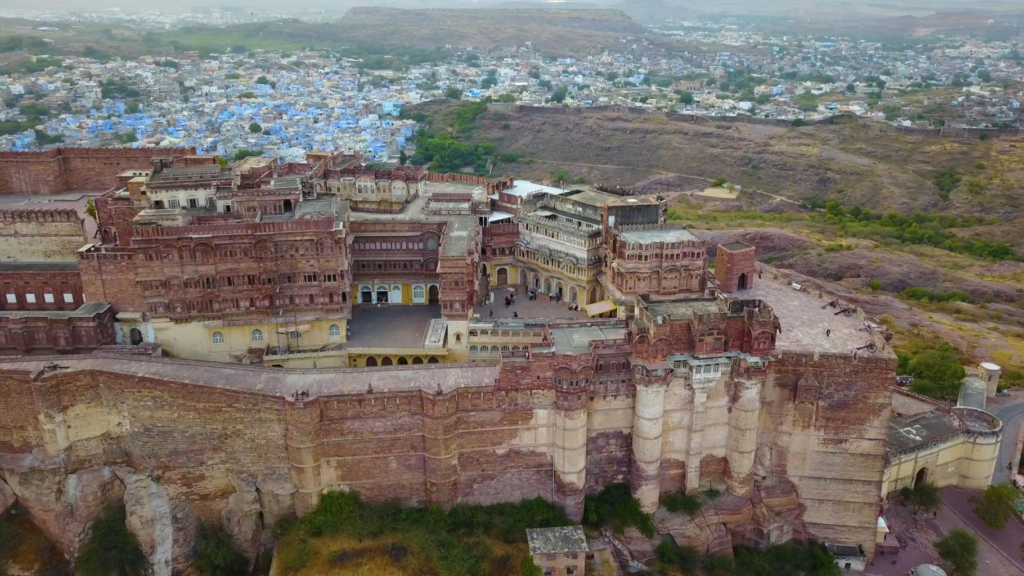
Sometimes when I think about Amber Fort and Mehrangarh Fort, the first thing that pops into my mind isn’t even the forts themselves, it’s the feeling of approaching them. Amber Fort feels like something that slowly reveals itself as you drive out of Jaipur city. The road toward Amer village has those random souvenir stalls selling miniature Rajasthani puppets and colorful turbans, and suddenly the fort appears above the Maota Lake like a painting someone forgot to remove from the background. Mehrangarh feels different in my memory. When you’re in Jodhpur, you almost feel the fort watching the entire city. The blue houses below make the hill look even steeper, and for some reason it always reminds me of those drone shots you see on travel channels where the fort looks completely dominating.
I remember once scrolling through hotel listings near Amber Fort and seeing Trident Jaipur, which sits near Mansagar Lake not too far from the fort road. It made me think Amber Fort is almost integrated with Jaipur’s tourist rhythm. You wake up in a hotel, eat breakfast, maybe stop near Hawa Mahal, then continue toward Amber. But Mehrangarh doesn’t feel like part of a tourist circuit in the same casual way. When people visit Jodhpur, the fort becomes the entire focus. Even if someone stays at RAAS Jodhpur, the terrace literally frames the fort like a giant stone backdrop.
Sometimes I also think about the color difference between the two. Amber Fort has that pale yellow sandstone and marble combination that almost glows in the afternoon sun. The courtyards inside have this slightly golden tone that reminds me of those old Bollywood historical films where the lighting always looks warm. Mehrangarh feels heavier. The stone is darker, almost reddish-brown, and the walls look thicker. Standing under its gates makes you feel the structure is almost aggressive in how it rises vertically.
Then my mind jumps to elephants. It’s funny how Amber Fort immediately connects with the elephant ride experience up the ramp to Suraj Pol. I’ve seen videos of tourists sitting on decorated elephants wearing bright fabrics, slowly climbing the pathway. I remember reading debates online about whether elephant rides should continue there. Mehrangarh never has that image in my head. When I picture its entrance, I think about the winding road where jeeps or taxis drive up. It feels more like entering a fortress than arriving at a palace complex.
And then suddenly I remember the inside spaces. Amber Fort always makes me think of the Sheesh Mahal. Those mirror mosaics covering the walls and ceilings are so detailed that even phone flashlight reflections bounce around the room. It feels decorative and almost delicate. Mehrangarh interiors, at least from the photos and videos I’ve seen, feel more museum-like. Rooms like the Phool Mahal are ornate too, but the atmosphere feels more like preserved history rather than decorative spectacle.
Something random always pops into my head when thinking about Amber Fort: Bollywood shooting locations. I think parts of Jodhaa Akbar used Amber-style architecture for its royal palace scenes. That association makes Amber feel slightly cinematic in my memory. Mehrangarh, on the other hand, reminds me of Hollywood sometimes. I remember reading that scenes from The Dark Knight Rises were filmed there when they needed that prison setting built into cliffs.
Food also randomly enters my thoughts for some reason. Around Amber Fort, I remember seeing small restaurants offering dal baati churma and lassi. Jaipur’s tourist culture means you’ll find places like 1135 AD, which is that famous fine-dining restaurant inside the fort complex. Eating royal Rajasthani cuisine inside a palace courtyard sounds like something designed for Instagram travel photos. Mehrangarh feels less about restaurants and more about the museum experience, though I know there are cafés nearby in the old city.
Then there’s the feeling of scale. Amber Fort spreads horizontally across the hillside. You walk through multiple courtyards and terraces and it feels like a palace complex slowly unfolding. Mehrangarh feels vertical and compact at the top of the hill even though it’s huge. The climb to reach the main gate gives it that sense of being almost unreachable historically.
Sometimes I think about the cities around them too. Jaipur feels organized, almost like a planned tourist destination. You have wide roads, the City Palace Jaipur, Jantar Mantar Jaipur, and the pink-painted buildings in the old city. Jodhpur feels more chaotic but also more atmospheric. Those blue houses around the fort make the entire city look like someone accidentally spilled blue paint across rooftops.
Then my mind drifts to how the forts look at sunset. Amber Fort with Maota Lake reflecting the walls almost feels calm and scenic. I once saw a photographer on Instagram capture the reflection perfectly with Jal Mahal visible on the way back to Jaipur. Mehrangarh at sunset feels dramatic instead. The shadows stretch across the blue city and the fort walls look darker and heavier.
Music sometimes enters the picture too. Mehrangarh hosts the Rajasthan International Folk Festival, and imagining folk musicians performing inside that massive fortress courtyard creates a completely different vibe. Amber Fort, in my mind, connects more with the evening Amber Fort Light and Sound Show, where the history of the Kachwaha rulers is narrated with dramatic lighting.
And weirdly, my brain sometimes jumps to travel logistics. Jaipur has an international airport and tons of train connections like Jaipur Junction railway station. So Amber Fort almost feels easier for first-time travelers. Jodhpur requires more planning sometimes unless someone flies directly into Jodhpur Airport or takes a train like the Mandore Express.
Another small detail that comes to mind is the gates. Mehrangarh has those massive gates like Jai Pol, and I remember reading about cannonball marks still visible on them from battles. Amber Fort’s gates feel more ceremonial than defensive.
And sometimes I think about the photography perspective. Amber Fort is photographed a lot from the lake side, with the zigzag ramp leading up the hill. Mehrangarh is usually photographed from the blue city rooftops. If you stand on a terrace café in Jodhpur, the fort almost fills the entire sky.
Even the atmosphere of the two places feels different in my imagination. Amber Fort feels royal and decorative, like a palace built for rulers who wanted beauty and grandeur. Mehrangarh feels like a stronghold first and a palace second. Its walls look like they were built to intimidate enemies.
And then randomly my thoughts go back to travel bloggers. Amber Fort appears constantly in Jaipur itineraries, sometimes in the same list as Nahargarh Fort and Jaigarh Fort because they sit along the same ridge. Mehrangarh feels like the single dominant monument of Jodhpur, almost like the city exists under its shadow.
Sometimes I imagine what it must have looked like centuries ago. Amber Fort probably buzzing with royal processions, elephants carrying nobles through the courtyards. Mehrangarh probably watching armies approaching across the desert landscape.
And that contrast keeps popping up in my mind. Amber feels like a palace complex where rulers lived comfortably. Mehrangarh feels like a fortress where rulers ruled from a position of strength.
It’s funny how even thinking casually about them keeps bringing me back to that feeling. One looks elegant and welcoming from a distance, reflected in a lake. The other rises sharply above a sea of blue houses, looking almost untouchable. Both are undeniably grand, but the mood they create in my mind is completely different.